Commercial fridge not holding temperature? Learn common causes, food safety checks, and when West Michigan businesses should call HomeHalo for repair.
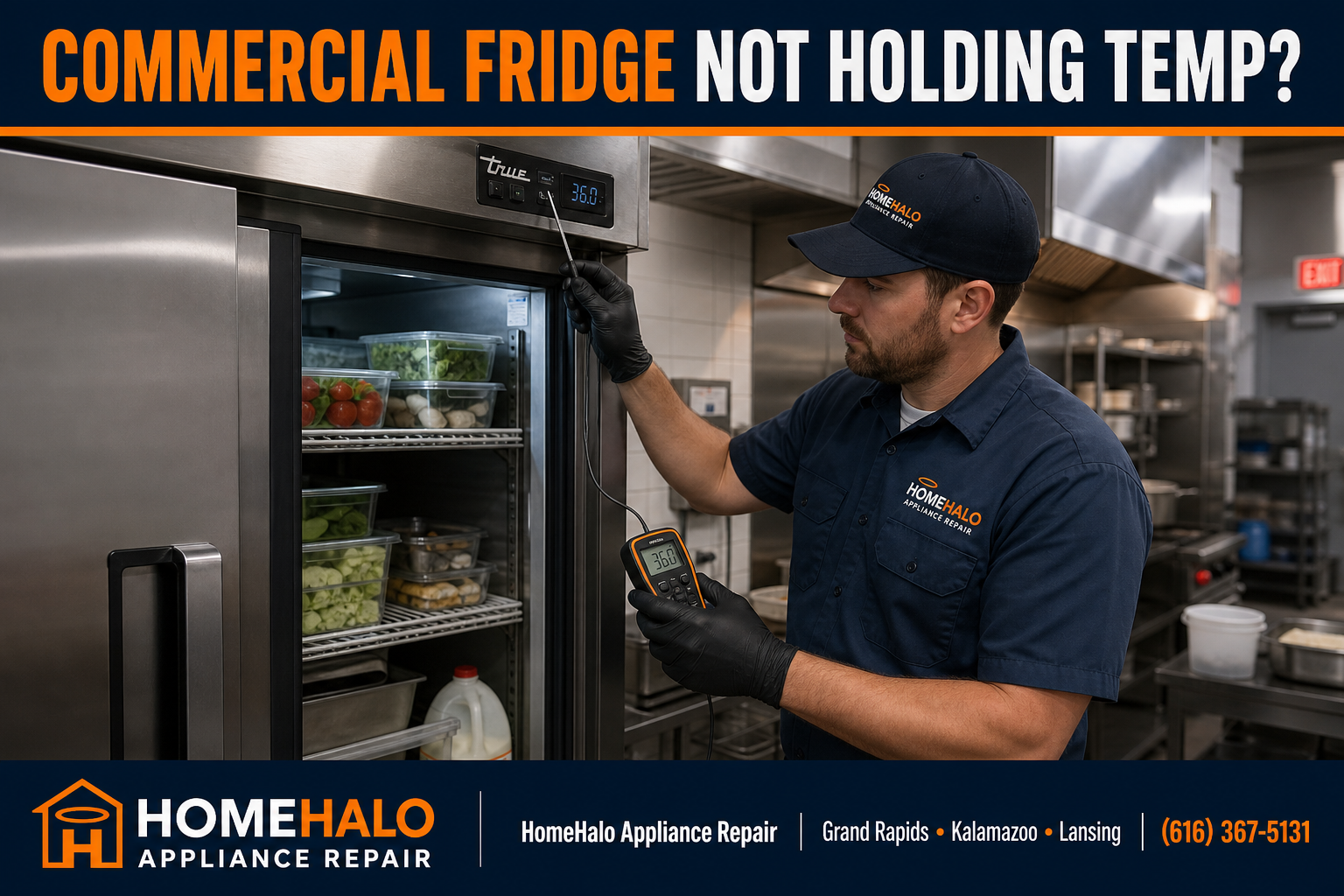
If your commercial refrigerator is not holding temperature, the most common causes are dirty condenser coils, blocked airflow, a worn door gasket, a failing evaporator fan, thermostat or sensor problems, low refrigerant, or a compressor issue. Move temperature-sensitive food to a safe backup cooler, document the temperatures, and schedule service quickly if the unit cannot stay at 40°F or below.
For restaurants, churches, offices, convenience stores, break rooms, and small food-service businesses in Grand Rapids, Kalamazoo, Lansing, and across West Michigan, a commercial refrigerator problem is more than an inconvenience. It can affect food safety, inventory cost, inspections, and daily operations. The goal is to separate simple environmental issues from repair problems before food spoils or the equipment gets damaged further.
What Temperature Should a Commercial Refrigerator Hold?
Most commercial refrigerators should hold food at 40°F or below. Many businesses aim for 34°F to 38°F to create a safety buffer, especially when doors are opened often during lunch rushes, catering prep, or evening service. Do not rely only on the display temperature. Use a separate refrigerator thermometer inside the cabinet and check temperatures in more than one location. A unit may show 37°F near the sensor while products on the top shelf or near the door are warmer because air is not circulating evenly.
If temperature rises briefly after a delivery or long door opening, it may recover. If it keeps climbing, runs constantly, or cannot pull back down after the door stays closed, treat it as a repair warning.
First, Protect the Food and Record the Pattern
Before troubleshooting the appliance, protect your inventory. Move meat, dairy, prepared food, medication, or other sensitive products into another working cooler if temperatures are unsafe. Keep doors closed as much as possible. If you are in a regulated food-service environment, follow your internal food safety policy and local health department guidance.
Then write down the cabinet temperature, whether the compressor and fans are running, whether ice is forming near the evaporator, whether the gasket is sealing, and whether anything changed recently such as a power outage, cleaning, delivery, or equipment move. This record helps a technician diagnose the issue faster.
Dirty Condenser Coils Are a Common Cause
Commercial refrigerators work hard, and condenser coils collect dust, flour, grease, pet hair, lint, and kitchen debris. When coils are dirty, the system cannot release heat efficiently. The compressor runs longer, cabinet temperature rises, and expensive parts can wear out faster.
Coils may be behind a front grille, near the bottom, on top of the unit, or behind an access panel. If they are visibly packed with debris, airflow is restricted.
Some cleaning is owner-maintenance, but be careful. Unplug the unit when appropriate, avoid bending fins, and do not spray water into electrical components. If the coils are difficult to access, the unit is built into tight cabinetry, or the refrigerator is already failing to cool, professional service is safer.
For a related residential explanation of coil problems, see our guide on refrigerator condenser coil cleaning.
Blocked Airflow Can Make One Area Warm
A commercial refrigerator needs open air paths. If boxes, pans, bottles, or food containers block the vents, the cold air cannot circulate. The unit may be cold near the evaporator but warm near the door, top shelf, or loaded product area.
Check whether product is pushed tightly against the back wall, stacked above the load line, or packed so tightly that air cannot move between items.
Leave space around vents and avoid overloading shelves. If airflow improves and temperatures recover, the appliance may not need a repair. If temperatures stay high even with proper loading and the doors closed, the problem is likely mechanical or electrical.
Door Gaskets Matter More Than Most People Think
A torn, loose, dirty, or hardened door gasket lets warm, humid air leak into the refrigerator. The unit may run constantly but never quite recover. You may also see condensation around the door, frost near the evaporator, wet floors, or food that feels warmer near the front of the cabinet.
Inspect the gasket all the way around the door. Look for cracks, gaps, grease buildup, warped corners, or places where the gasket has pulled away from the door. Clean sticky residue with mild soap and warm water. If the gasket is damaged or no longer seals evenly, replacement is usually the right fix.
This is especially important in West Michigan during warmer, humid months. Every door opening brings in moisture. A weak gasket turns normal humidity into a constant load on the refrigeration system.
Fan Problems Can Stop Cold Air From Moving
Commercial refrigerators typically use evaporator fans to move cold air through the cabinet and condenser fans to remove heat from the refrigeration system. If either fan is weak, blocked, noisy, or not running, temperatures can climb quickly.
Signs of a fan problem include uneven temperatures, rattling or squealing noises, warm spots in the cabinet, ice forming near the evaporator, or a compressor that seems to run without cooling the box. Sometimes a fan is blocked by ice. Other times the motor, wiring, control board, or fan blade has failed.
Do not ignore strange fan noises. A failing fan can turn a manageable repair into spoiled inventory and compressor stress. Our guide on refrigerator loud noises explains warning sounds that also apply to many commercial cooling systems.
Thermostat, Sensor, and Control Issues
If the refrigerator display looks wrong, jumps around, or does not match a separate thermometer, the issue may involve a thermostat, thermistor, temperature probe, control board, relay, or wiring problem. The refrigerator may shut off too early, run at the wrong time, or fail to trigger cooling when the cabinet warms up.
This is where guessing gets expensive. Replacing a thermostat will not fix a sealed-system issue. Replacing a sensor will not fix blocked airflow. A proper diagnosis checks the temperature reading, the call for cooling, compressor operation, fans, defrost behavior, and electrical signals.
If your refrigerator is warm but the compressor seems to run, see our related article on why a refrigerator is warm but the freezer is cold for a helpful comparison of airflow and cooling problems.
Ice Buildup Can Point to Defrost or Air Leak Problems
Ice on the evaporator cover, back wall, or fan area can block airflow and raise cabinet temperature. Causes include a failed defrost heater, bad defrost timer or control, clogged drain, faulty sensor, weak door seal, or repeated door openings that bring humid air into the cabinet.
Do not chip ice with a knife or screwdriver. That can puncture refrigerant lines and turn a repairable appliance into a major replacement decision. If you need to protect inventory, move the food and shut the unit down only if it is safe for your operation. Then schedule service.
For more background on frost patterns, read why ice builds up in a freezer. Commercial units are different from home freezers, but the airflow and defrost principles are similar.
Low Refrigerant or Compressor Problems Need Professional Diagnosis
If coils are clean, airflow is open, gaskets seal, fans run, and the unit still cannot hold temperature, the issue may involve refrigerant charge, a leak, restriction, compressor weakness, start components, or the sealed system. These are professional repairs.
Low refrigerant is not something a refrigerator “uses up” during normal operation. If refrigerant is low, there is usually a leak or another sealed-system problem. Adding refrigerant without finding the cause may only create a temporary improvement.
Compressor problems can also look like temperature drift, clicking, humming, short cycling, or a refrigerator that runs but never gets cold enough.
When Should a West Michigan Business Call for Repair?
Call for commercial refrigerator repair when the unit cannot hold 40°F or below, temperature keeps rising with the door closed, product is at risk, fans are not running, ice is blocking airflow, the compressor is clicking or very hot, or the same issue returns after cleaning and reloading the cabinet.
HomeHalo services commercial and residential appliances across Grand Rapids, Kalamazoo, Lansing, and West Michigan. We work on refrigerators, freezers, dishwashers, ovens, washers, dryers, and major appliance brands.
How HomeHalo Handles Commercial Refrigerator Problems
HomeHalo starts with a focused diagnostic visit. For HomeHalo diagnostic pricing, the diagnostic fee applies toward the repair when appropriate. The goal is to identify the actual failure instead of replacing parts based on symptoms alone.
A technician may check temperature readings, condenser condition, airflow, door gaskets, fan operation, defrost behavior, compressor operation, electrical components, and signs of refrigerant or sealed-system issues. After diagnosis, you get a clear explanation of what failed, whether repair makes sense, and what needs to happen next.
If your commercial refrigerator is not holding temperature in Grand Rapids, Kalamazoo, Lansing, or nearby West Michigan, contact HomeHalo Appliance Repair. Call (616) 367-5131 or request service through our verified live contact page: https://homehalorepair.com/contact/.
Need appliance repair in West Michigan?
Same-day service available. Honest pricing. nearly 600 five-star reviews.
Find appliance repair near you
Need help with an appliance? Choose your nearest city to explore repair services and nearby coverage.
When to Call a Professional
- → The appliance makes burning, sparking, or unusual electrical smells
- → DIY troubleshooting hasn't resolved the issue after one attempt
- → The repair involves gas lines, electrical components, or sealed refrigerant systems
- → The appliance is still under warranty (DIY may void it)
HomeHalo serves Grand Rapids, Lansing, Kalamazoo & West Michigan. (616) 367-5131
💡 Key Takeaway
When in doubt, a professional diagnosis costs less than guessing wrong. HomeHalo provides free estimates and upfront quotes, you'll know the cost before any work begins. Call (616) 367-5131 for same-day service across West Michigan.