Oven taking too long to preheat? Learn common causes, safe checks, and when West Michigan homeowners should call HomeHalo for oven repair.
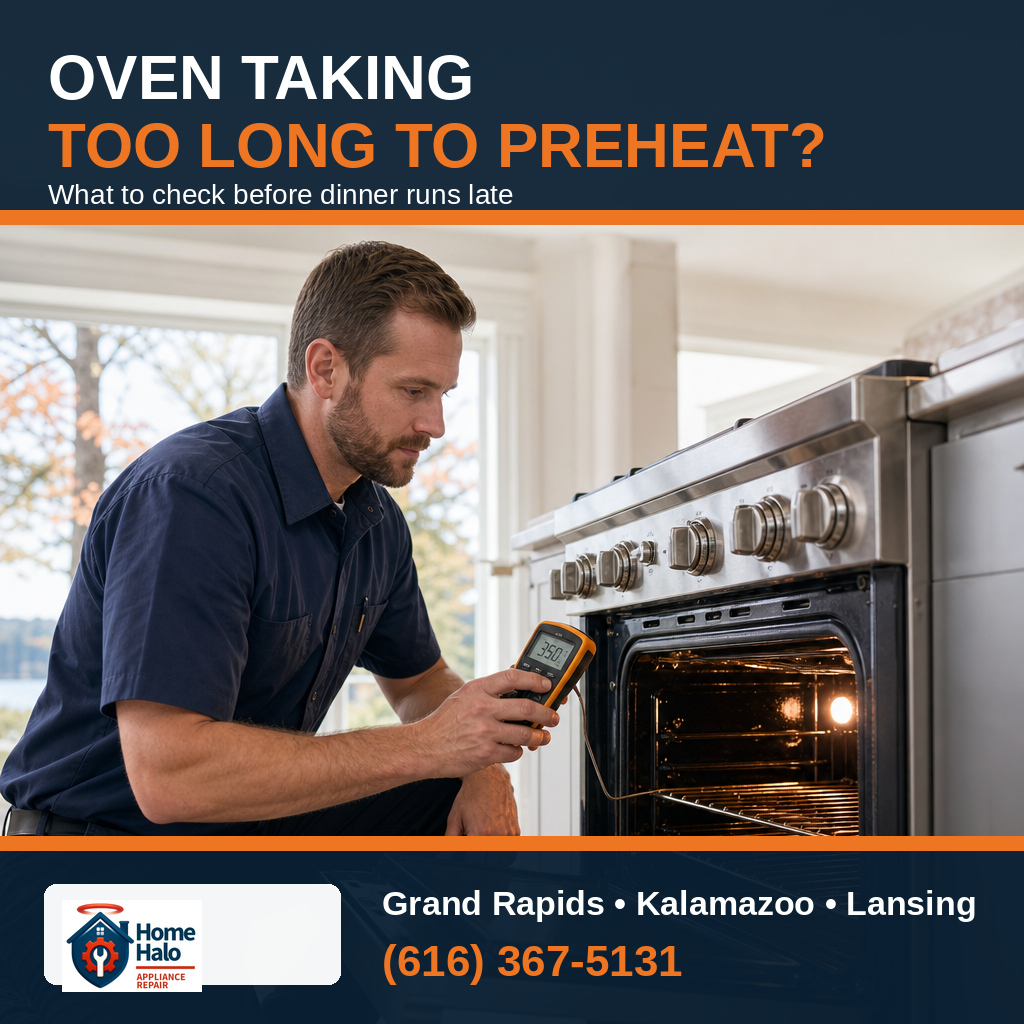
If your oven is taking too long to preheat, the most common causes are a weak bake element, failing gas igniter, bad temperature sensor, damaged door gasket, dirty burner assembly, incorrect power supply, or a control problem. A normal oven often reaches 350°F in about 10 to 20 minutes, depending on the model. If yours now takes 30 minutes or more, heats unevenly, or never reaches the set temperature, treat it as a repair warning instead of just an inconvenience.
This problem shows up often in Grand Rapids, Kalamazoo, Lansing, and across West Michigan when families start cooking more for graduation parties, summer gatherings, and busy weeknight meals. A slow-preheating oven can waste energy, throw off recipes, and point to parts that are getting weaker.
First, confirm it is actually preheating slowly
Before assuming the oven is broken, compare it against a real thermometer. Many ovens beep when the control board thinks the oven is ready, but the actual center-rack temperature may still be lower than the display suggests.
Place an inexpensive oven thermometer in the center of the middle rack. Set the oven to 350°F. Wait until the oven says it is preheated, then check the thermometer. Check again after another 10 minutes.
You are looking for patterns:
- If the oven eventually reaches temperature but takes much longer than it used to, a heating component may be weak.
- If the oven says it is ready but the thermometer is 25°F or more off, the sensor or calibration may be wrong.
- If the oven never reaches the set temperature, the issue is more likely a failed element, igniter, control, or power problem.
- If one area burns while another stays pale, airflow or one heating source may be failing.
For related temperature problems, see Whirlpool oven temperature problems and convection oven not heating evenly.
Electric ovens: the bake element may be weak or failing
In many electric ovens, the lower bake element does most of the work during preheat. Some models also use the broil element for faster preheating, but the bake element still matters. When it starts to fail, the oven may heat slowly, cook unevenly, or stop heating altogether.
With the oven empty, turn it on and watch the lower element after a few minutes. A healthy element usually glows evenly red. A failing element may have dark spots, blistering, visible breaks, bright hot spots, or no glow at all.
Do not touch the element while testing. Turn the oven off if you see sparking, arcing, or a section that looks damaged. A failing element can sometimes trip the breaker during preheat. If that happens, read why an oven trips the breaker when it preheats.
A bake element is often a worthwhile repair, especially on an otherwise reliable oven. The key is confirming whether the element itself failed or whether the control board is failing to send power to it.
Gas ovens: a weak igniter is a leading cause
If you have a gas oven, slow preheat often points to the igniter. A gas oven igniter has two jobs: it gets hot enough to light the burner, and it draws enough current to open the gas safety valve. When the igniter weakens, it may still glow, but not strongly enough to open the valve quickly.
Common signs include:
- The oven takes longer and longer to start heating
- You see an orange glow but the burner lights late
- You smell faint gas before ignition
- The oven heats, but preheat takes much longer than it used to
- Baking temperatures swing or recovery is slow after the door opens
If you smell strong gas, shut the oven off, ventilate the area, and do not keep trying to light it. For a deeper gas-oven explanation, see why a gas oven takes too long to ignite and gas oven igniter replacement cost and signs.
A bad temperature sensor can mislead the oven
Most modern ovens use a temperature sensor, sometimes called an RTD probe, to tell the control board how hot the oven cavity is. If that sensor reads incorrectly, the oven may shut heat off too early, run too long, or cycle in a way that makes preheating unpredictable.
A sensor problem can look like a heating problem because the symptom is the same: the oven does not behave like the temperature you selected. You may notice cookies taking longer, casseroles cooking unevenly, or meats needing extra time even though the display says the oven is ready.
Some ovens allow calibration through the settings menu. Calibration can help when the oven is consistently off by a small amount. It will not fix a failing sensor, damaged wiring, bad relay, or weak heating component. If the temperature swing is large, random, or getting worse, diagnosis is the better path.
Heat may be escaping through the door
A worn oven door gasket can make preheating drag on because heat escapes faster than the oven can build it. This is especially common on older ranges or ovens that have had years of heavy use.
Check the gasket around the oven door. Look for flattened areas, tears, hardened rubber, loose clips, or sections that have pulled away. Also make sure the door closes fully and sits square. A bent hinge, damaged latch, or door that does not seal can create the same problem.
A quick clue is heat escaping around the door during preheat. Some warmth is normal, but a strong blast of hot air from one side suggests the seal or door alignment needs attention.
If the door itself is the problem, see oven door won’t close properly and oven glass door cracked replacement.
Power supply issues can make electric ovens heat slowly
Electric ranges usually need 240 volts. If one leg of power is missing, loose, or interrupted, some functions may appear to work while the oven heats poorly or not at all. The display may light up, the clock may work, and the stovetop may partly function, but the oven still struggles.
This can happen after electrical work, a breaker problem, a damaged outlet, or a cord issue. Because this involves high voltage, do not pull the range apart unless you are trained and equipped to test it safely.
If your oven suddenly started preheating slowly after a power event, storm, or electrical change, the appliance may not be the only thing to check. West Michigan spring storms and power blips can damage control boards, relays, and electrical connections.
Dirty burners, blocked airflow, and overloaded ovens
Not every slow preheat is a failed part. Grease buildup, foil on the oven floor, blocked vents, oversized pans, and too many racks can all affect heating.
Avoid lining the oven floor with foil unless the manufacturer specifically allows it. Foil can block airflow, reflect heat toward places it should not go, and damage the oven finish. Keep racks positioned normally during preheat. If you are using large roasting pans or baking stones, allow extra time because those items absorb heat.
For gas ovens, heavy grease or debris near the burner can affect flame quality. A weak or uneven flame needs professional attention, especially if you smell gas or see yellow flames.
When to call for oven repair
Schedule service if the oven takes more than 30 minutes to preheat, never reaches the set temperature, trips the breaker, smells like gas, sparks, shows error codes, or has large temperature swings confirmed by a thermometer.
A professional diagnosis should check the heating element or igniter, sensor readings, voltage supply, wiring, relay operation, control board output, gasket condition, and burner performance where applicable. That matters because replacing parts based on symptoms alone can get expensive fast.
HomeHalo’s diagnostic visit is $179 and applies toward the repair when appropriate. That gives you a clear answer before deciding whether to repair the oven or replace it.
How to prevent slow preheat from becoming a bigger problem
Use an oven thermometer occasionally, especially before holidays or family gatherings. Keep the oven interior clean, but be cautious with self-clean cycles on older ovens because the extreme heat can stress control boards, locks, and sensors. Do not ignore new smells, sparks, breaker trips, or preheat times that keep getting longer.
If your oven is taking too long to preheat in Grand Rapids, Kalamazoo, Lansing, or anywhere in West Michigan, HomeHalo Appliance Repair can help. We service all major oven and range brands for residential and commercial customers. Call (616) 367-5131 or request service through our verified live contact page: https://homehalorepair.com/contact/.
Need appliance repair in West Michigan?
Same-day service available. Honest pricing. nearly 600 five-star reviews.
Find appliance repair near you
Need help with an appliance? Choose your nearest city to explore repair services and nearby coverage.
When to Call a Professional
- → The appliance makes burning, sparking, or unusual electrical smells
- → DIY troubleshooting hasn't resolved the issue after one attempt
- → The repair involves gas lines, electrical components, or sealed refrigerant systems
- → The appliance is still under warranty (DIY may void it)
HomeHalo serves Grand Rapids, Lansing, Kalamazoo & West Michigan. (616) 367-5131
💡 Key Takeaway
When in doubt, a professional diagnosis costs less than guessing wrong. HomeHalo provides free estimates and upfront quotes, you'll know the cost before any work begins. Call (616) 367-5131 for same-day service across West Michigan.