Oven temperature wrong after preheating? Learn safe checks, common causes, and when West Michigan homeowners should call HomeHalo.
If your oven temperature is wrong after preheating, the direct answer is that the oven may be cycling normally, reading temperature from a weak sensor, losing heat through the door, heating unevenly because of a failing element or igniter, or being affected by airflow and calibration settings. Do not judge the oven by one quick thermometer glance the moment it beeps. Give it time to stabilize, then compare the actual temperature over several cycles. If the oven is consistently 25°F, 50°F, or more away from the setting, it needs diagnosis before you keep ruining meals or replacing parts by guesswork.
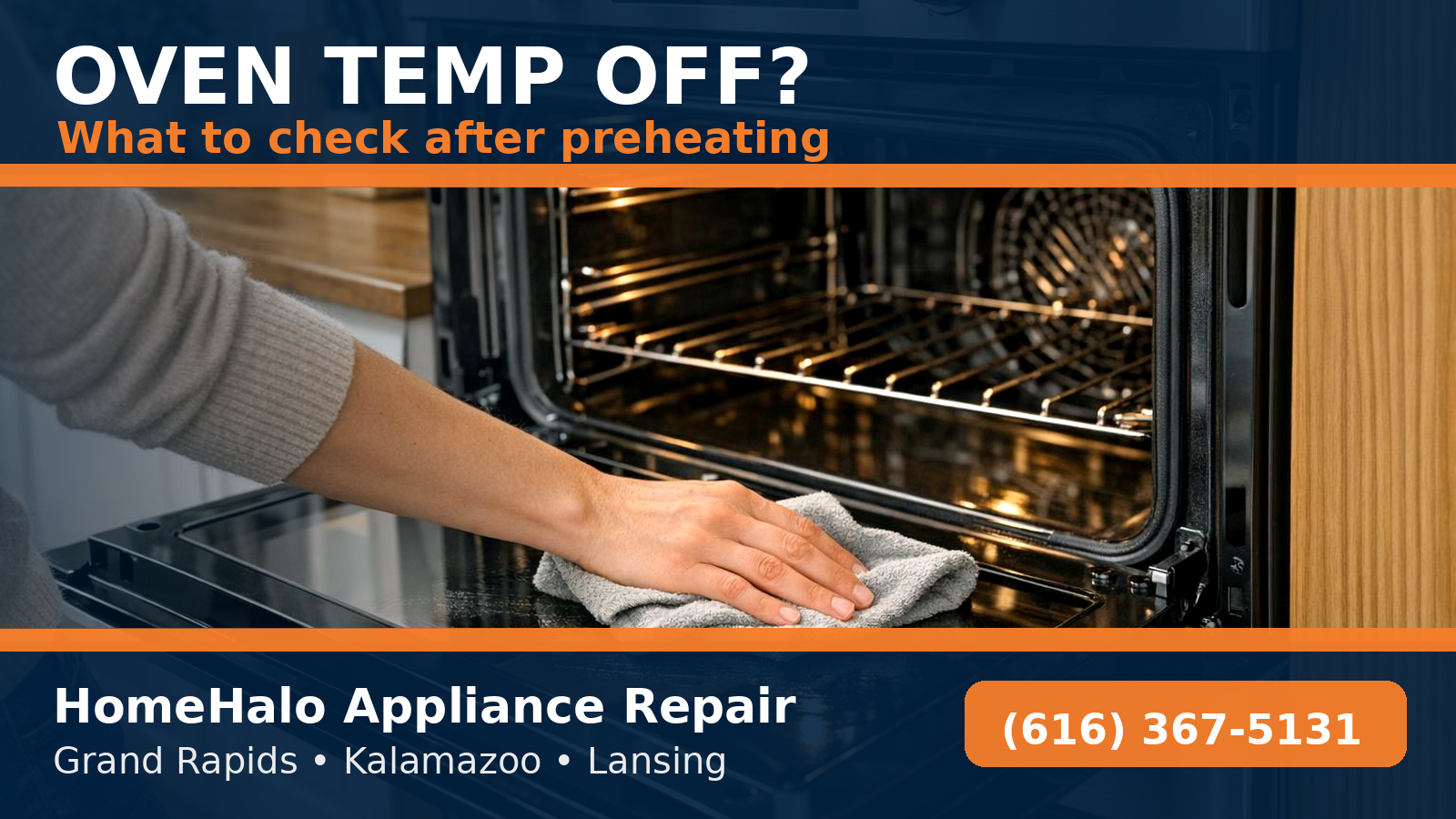
HomeHalo gets this call from homeowners in Grand Rapids, Kalamazoo, Lansing, and nearby West Michigan when cookies brown on one side, casseroles take too long, or the oven says it is ready but the food says otherwise. An inaccurate oven is often repairable. The key is separating normal temperature cycling from a real control, sensor, airflow, door, element, or gas ignition problem.
First, understand that preheat beeps can be early
Many ovens beep before every surface inside the oven cavity is fully heat-soaked. The air near the sensor may reach the target temperature first, while racks, walls, sheet pans, and door glass are still catching up. That is why an oven can beep at 350°F and still behave like it is not truly ready for a delicate bake.
For quick weeknight cooking, the beep may be good enough. For baking, roasting, or anything temperature-sensitive, give the oven another 10 to 15 minutes after the preheat signal. If your oven also takes an unusually long time to get to temperature, compare your symptoms with our guide on why an oven takes so long to preheat.
Use an oven thermometer the right way
A single oven thermometer reading can mislead you. Ovens cycle above and below the set temperature. For example, an oven set to 350°F may rise to 375°F, shut the heat off, drift down to 325°F, then heat again. The average matters more than one instant reading.
Place a reliable oven thermometer near the center rack, not touching a pan or wall. Preheat the oven, wait 10 to 15 minutes after the beep, then record the temperature every 5 minutes for 20 to 30 minutes. If the average is close to the setting, the oven may be working normally. If the average stays far off, you have a real issue.
Check rack position, pans, and airflow
Before assuming a failed part, look at how the oven is loaded. Crowded racks, oversized foil pans, baking sheets that cover most of the rack, and foil on the oven floor can block airflow. That can make one area too hot and another too cool even when the sensor and control are doing their job.
Use the center rack for most baking. Leave space around pans so air can move. Avoid lining the oven floor with foil unless the manufacturer specifically allows it. Foil can reflect heat, block vents, damage the liner, and interfere with temperature readings. If your oven has convection, make sure the fan is actually running when convection mode is selected. For uneven cooking patterns, you may also want to read why a convection oven is not heating evenly.
Door gasket and hinge problems leak heat
An oven can heat correctly at first and still cook poorly if heat escapes around the door. A torn gasket, bent hinge, weak door spring, damaged latch, or door that does not close flush can let hot air leak out. The control responds by adding more heat, but food near the leak may still cook unevenly.
Look at the door from the side. Does it sit flat against the frame? Does one corner stick out? Is the gasket torn, hardened, greasy, or hanging loose? Do not tug hard on the gasket or force the door closed. Oven doors are heavy, and bending a hinge can turn a small problem into a larger repair.
If the door recently locked after self-clean or will not close normally, the lock mechanism or hinges may need service. We have a separate article on what to do when a Bosch oven door is locked and will not open because forcing a locked oven door can crack glass or bend the latch.
Electric ovens: bake and broil elements matter
Most electric ovens use a bake element at the bottom and a broil element at the top. Some models hide the bake element under the oven floor. During preheat, many ovens use both elements to heat quickly, then rely more heavily on the bake element to maintain temperature.
If the bake element is weak, cracked, blistered, or not heating, the oven may preheat slowly, miss the set temperature, or brown food incorrectly. If the broil element is not contributing during preheat, the oven may take longer and recover poorly after the door is opened. A hidden bake element can fail without the obvious red glow homeowners expect to see.
Do not touch or remove an element while the oven is connected to power. Electric ovens use high voltage, and a failed element can also involve wiring, relays, thermal limits, or the control board. If the oven is not heating at all, our guide on electric oven elements not working explains the common clues.
Gas ovens: weak igniters can cause low or uneven heat
In many gas ovens, the igniter must draw enough current to open the gas valve and light the burner properly. A weak igniter may still glow, so it can look like it is working, but the burner may light late, cycle inconsistently, or fail to produce steady heat.
Signs include slow ignition, a delayed whoosh, gas odor during startup, long preheat times, temperature that drops during cooking, or food that takes much longer than expected. If you smell gas strongly, hear hissing, feel dizzy, or the odor continues when the oven is off, leave the area and contact the gas utility or emergency service from a safe location.
For less urgent slow-lighting symptoms, see why a gas oven takes so long to ignite. Gas ignition problems are not a place to guess. The igniter, safety valve, burner, wiring, and control signal need to be checked safely.
The temperature sensor can drift or fail
The oven temperature sensor is usually a small metal probe inside the oven cavity. It tells the control board how hot the oven is. If the sensor is out of range, loose, damaged, touching the oven wall, or connected through a wiring problem, the control may think the oven is hotter or cooler than it really is.
A drifting sensor can cause an oven to run consistently too hot or too cool. Sometimes the display looks normal, but baking results are not. Other times the oven may show an error code or shut down. A technician can test the sensor resistance, inspect the connector, check the control response, and confirm whether the sensor or board is at fault.
Some ovens allow temperature calibration through the control panel. Calibration can be useful when the oven is consistently off by a modest amount, but it should not be used to hide a failing sensor, weak igniter, bad element, or leaking door. If the oven is off by a large amount or keeps changing, diagnose the cause first.
Self-clean can expose weak oven parts
Self-clean cycles run much hotter than normal baking and can stress door locks, sensors, wiring, thermal fuses, controls, and heating elements. If the temperature problem started right after self-clean, avoid running another self-clean cycle as a test and mention the timing when scheduling service.
When should you call for oven repair?
Call for service if the oven is consistently more than about 25°F off after proper testing, if the preheat time has changed sharply, if food burns on one side and stays pale on the other, if the door does not seal, if you smell gas, if an element will not heat, if the oven shows an error code, or if the temperature swings are getting worse. Also call if you already tried calibration and the problem returned.
HomeHalo Appliance Repair serves Grand Rapids, Kalamazoo, Lansing, and surrounding West Michigan communities. During an oven temperature visit, the technician checks the actual temperature pattern, sensor reading, bake and broil elements, gas igniter performance when applicable, door seal, hinges, airflow, control signals, wiring, and model-specific calibration settings. The standard diagnostic is $179 and applies toward repair when appropriate, so you get a clear explanation before approving work.
If your oven temperature is wrong after preheating, call HomeHalo at (616) 367-5131 or use our verified contact page at homehalorepair.com/contact/. We will help you get back to reliable cooking without pushing replacement by default.
Need appliance repair in West Michigan?
Same-day service available. Honest pricing. nearly 600 five-star reviews.
Find appliance repair near you
Need help with an appliance? Choose your nearest city to explore repair services and nearby coverage.
When to Call a Professional
- → The appliance makes burning, sparking, or unusual electrical smells
- → DIY troubleshooting hasn't resolved the issue after one attempt
- → The repair involves gas lines, electrical components, or sealed refrigerant systems
- → The appliance is still under warranty (DIY may void it)
HomeHalo serves Grand Rapids, Lansing, Kalamazoo & West Michigan. (616) 367-5131
💡 Key Takeaway
When in doubt, a professional diagnosis costs less than guessing wrong. HomeHalo provides free estimates and upfront quotes, you'll know the cost before any work begins. Call (616) 367-5131 for same-day service across West Michigan.