Refrigerator door alarm going off? Learn common causes, safe checks, and when West Michigan homeowners should call HomeHalo.
If your refrigerator door alarm keeps going off, the direct answer is that the refrigerator thinks a door is open, the temperature is rising, or a sensor is not reading correctly. Start by checking whether the door is fully closed, food or drawers are blocking the seal, the gasket is dirty or loose, and the refrigerator is still cooling normally. If the alarm continues after those basics, the problem may involve the door switch, hinge alignment, control board, temperature sensor, or airflow.
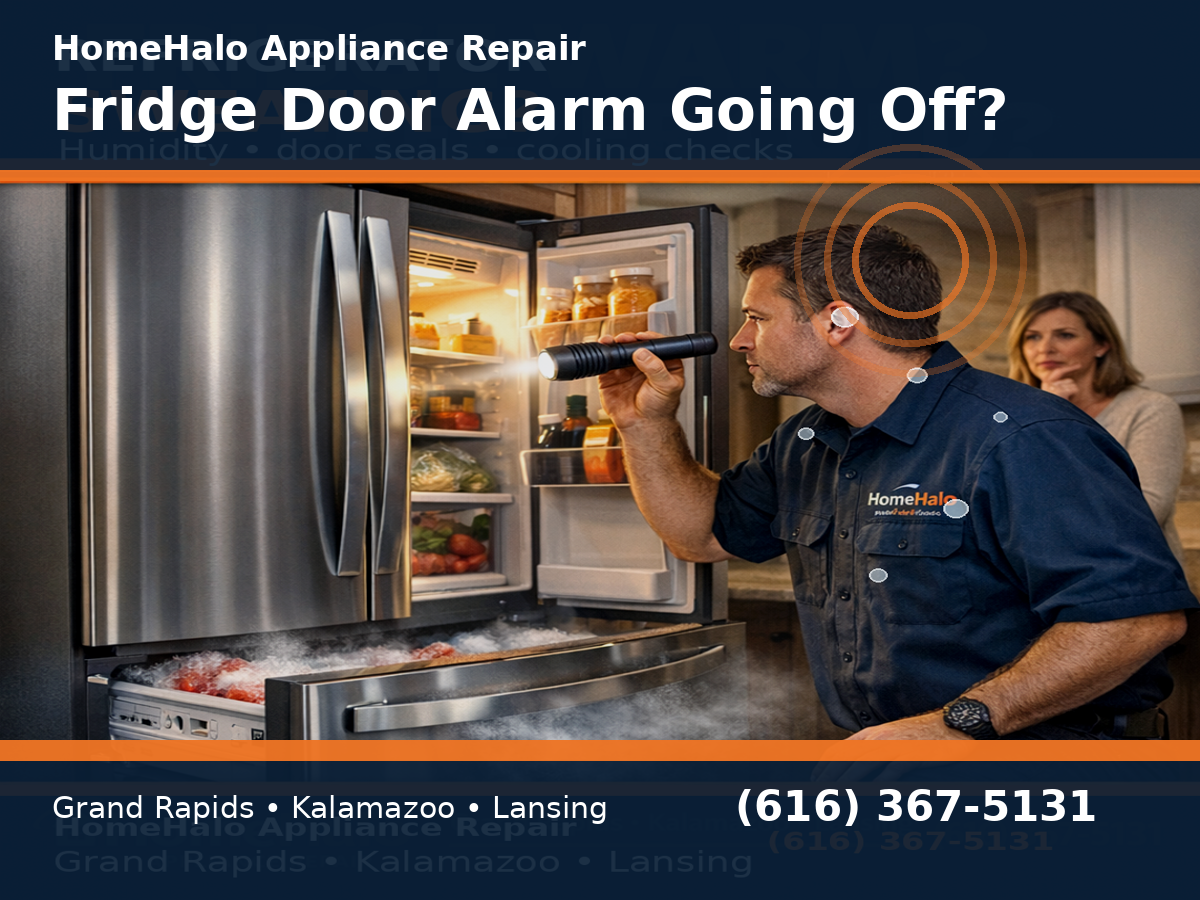
HomeHalo gets this question from homeowners in Grand Rapids, Kalamazoo, Lansing, and across West Michigan because modern refrigerators are more alert than older models. A beeping door alarm can be helpful when a child leaves the door cracked open. But when it keeps beeping with the doors closed, it becomes annoying and can point to a cooling problem that should not be ignored.
First, make sure the refrigerator is actually closed
This sounds obvious, but it is the best first check. Refrigerator doors can look closed from across the kitchen while a drawer, bin, food package, water filter cover, or ice bucket keeps the gasket from sealing all the way.
Open both the fresh-food and freezer sections. Push drawers fully in. Move tall bottles, pizza boxes, produce bags, or containers away from the door shelves. Check that crisper drawers and deli drawers are sitting on their tracks. On French door refrigerators, make sure the center mullion or flap between the doors folds into the right position.
After closing the doors, listen for a soft seal and watch whether the light turns off. If the interior light stays on, or the alarm starts again within a minute or two, the refrigerator may still not be recognizing a closed door.
Check the door gasket for gaps or dirt
The gasket is the flexible seal around the door. If it is sticky, torn, folded, loose, or packed with crumbs, cold air can leak out and warm humid air can leak in. That can trigger a door alarm, a high-temperature warning, sweating, frost, or longer run times.
Wipe the gasket with warm water and mild soap, then dry it. Pay attention to the corners and the hinge side where grime collects. Do not use harsh chemicals that can dry out the rubber. Look for cracks, flattened spots, or areas where the gasket has pulled out of its channel.
A simple dollar-bill test can help: close the door on a bill and gently pull. You should feel resistance. Test several spots around the door. If the bill slides out easily in one area, that spot may not be sealing. If you are also seeing condensation outside the cabinet, compare your symptoms with our guide on why a refrigerator is sweating on the outside.
Door alignment and hinges can fool the alarm
A refrigerator that is slightly out of level may not close consistently. Heavy door shelves can also pull a door down over time. When the hinge side sags or the cabinet tilts forward, the door may rebound open a tiny amount after you walk away.
Watch the door from the side as it closes. Does it meet the frame evenly? Does one corner touch before the other? Does the door slowly drift open instead of closing by itself? Those clues point to leveling, hinge, cam, or door-weight issues.
Do not force a sagging door shut or slam it harder. That can make hinge and gasket problems worse. A technician can check leveling, hinge wear, mullion alignment, door cams, and whether the door is twisted or overloaded.
The door switch may be stuck or failing
Most refrigerators have a door switch or magnetic sensor that tells the control board when the door is open. It also controls the interior light on many models. If the switch sticks, breaks, or loses alignment, the refrigerator may think the door is open even when it is sealed.
Look for a small plunger switch near the door frame, or check your owner manual for magnetic sensor locations. Do not pry at hidden sensors or remove panels. You can usually test the obvious plunger style by pressing it gently with the door open. If the light flickers, does not turn off, or the alarm changes when you touch the switch, mention that when scheduling service.
Door-switch problems can also affect cooling behavior. Some models reduce fan operation when a door is open. If the refrigerator falsely thinks the door is open, airflow may suffer and temperatures can rise.
Temperature alarms are different from door alarms
Not every beep is a door alarm. Many refrigerators beep when the freezer or fresh-food compartment gets too warm. That can happen after a power outage, after a grocery trip, during a defrost issue, or when a cooling component is failing.
Check the display for words like door, high temp, power outage, alarm, or an error code. If you have a thermometer, the fresh-food section should generally be near 37°F and the freezer near 0°F. If the refrigerator is above 40°F or the freezer is softening, treat the alarm as a cooling warning, not just a nuisance.
A refrigerator that is warm inside but the freezer still feels cold may have an airflow or defrost issue. Our article on why a refrigerator is warm but the freezer is cold explains that symptom in more detail. If the refrigerator is also clicking on and off, see why a refrigerator clicks repeatedly.
Recent power outages can trigger alerts
West Michigan storms and short power interruptions can leave a refrigerator in an alarm state. Some models remember a power loss and beep until you acknowledge the alert. Others beep because temperatures rose during the outage and have not recovered yet.
If the display shows a power-loss warning, acknowledge it according to the owner manual and monitor temperatures. Do not assume food is safe just because the alarm stopped. If the refrigerator was without power for a long time or food feels warm, follow food-safety guidance.
If water appears after an outage, you may be dealing with melted frost, a defrost drain issue, or an ice maker/water-line problem. We have a separate guide on why a refrigerator leaks water after a power outage.
Ice makers and dispensers can block the door
French door and side-by-side refrigerators often have ice buckets, dispenser flaps, and freezer baskets that must sit exactly right. A shifted ice bin or a frozen dispenser flap can keep the door from closing or make the control think something is not in position.
Remove only the bins your manual allows, then reinstall them carefully. Make sure the ice bucket is seated and the freezer baskets slide all the way back. If ice is clumped, the dispenser flap is stuck, or the door has frost around the chute, stop forcing it. Ice buildup can damage plastic parts and create more sealing problems.
When should you call for refrigerator repair?
Call for service if the alarm keeps returning after the doors, drawers, gasket, and obvious obstructions are checked. Also call if the refrigerator is warming, the freezer is soft, the door will not seal, the light stays on, the alarm appears with an error code, or the issue started after a power surge.
HomeHalo Appliance Repair serves Grand Rapids, Kalamazoo, Lansing, and nearby West Michigan communities. During a refrigerator alarm visit, the technician checks temperatures, door closure, gasket condition, hinge alignment, door switches, sensors, fans, defrost behavior, and control signals. The standard diagnostic is $179 and applies toward repair when appropriate, so you get a clear answer before deciding on the repair.
If your refrigerator door alarm will not stop beeping, call HomeHalo at (616) 367-5131 or visit our verified contact page at homehalorepair.com/contact/.
Need appliance repair in West Michigan?
Same-day service available. Honest pricing. nearly 600 five-star reviews.
Find appliance repair near you
Need help with an appliance? Choose your nearest city to explore repair services and nearby coverage.
When to Call a Professional
- → The appliance makes burning, sparking, or unusual electrical smells
- → DIY troubleshooting hasn't resolved the issue after one attempt
- → The repair involves gas lines, electrical components, or sealed refrigerant systems
- → The appliance is still under warranty (DIY may void it)
HomeHalo serves Grand Rapids, Lansing, Kalamazoo & West Michigan. (616) 367-5131
💡 Key Takeaway
When in doubt, a professional diagnosis costs less than guessing wrong. HomeHalo provides free estimates and upfront quotes, you'll know the cost before any work begins. Call (616) 367-5131 for same-day service across West Michigan.