Learn why your refrigerator is warm but the freezer is cold, what to check first, and when to call HomeHalo for trusted West Michigan refrigerator repair.
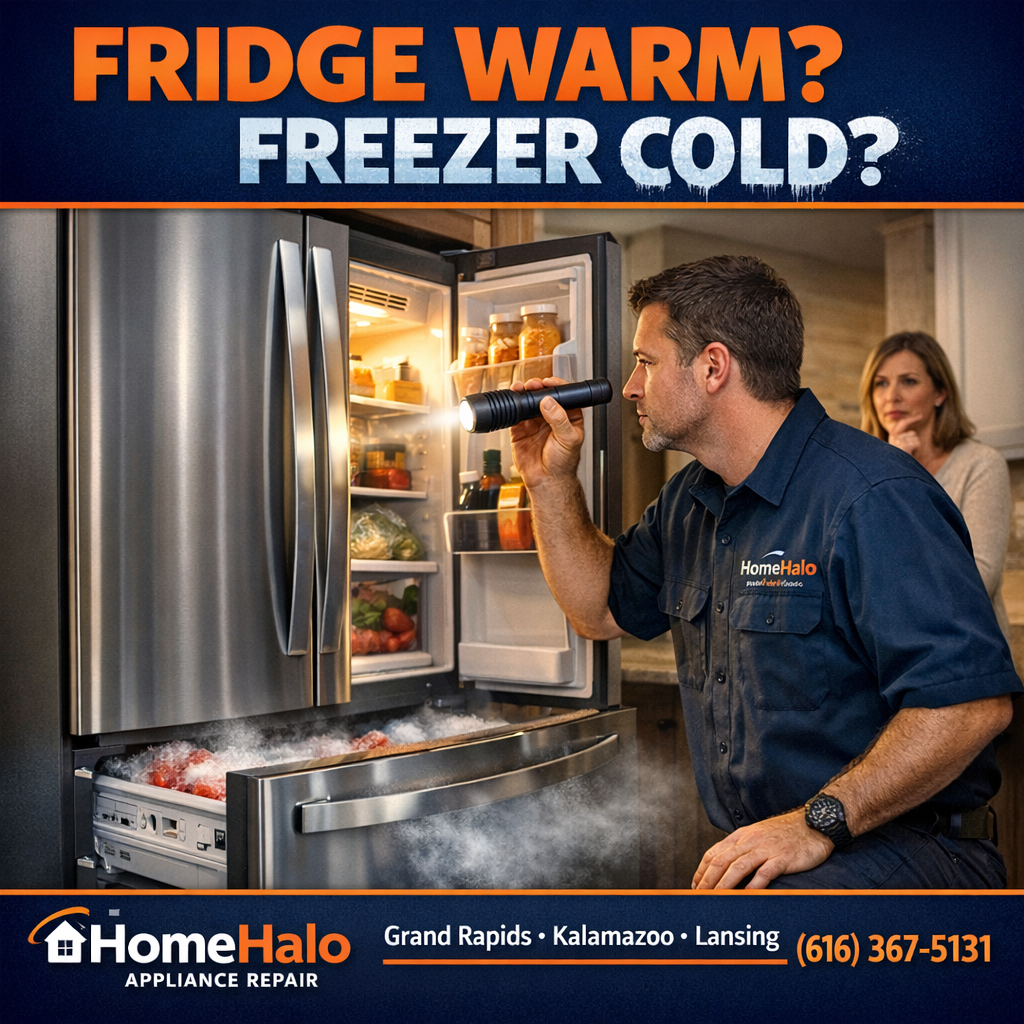
If your refrigerator is warm but the freezer is still cold, the most likely cause is an airflow problem between the freezer and fresh food section. The freezer makes most of the cold air, then a fan and damper move that air into the refrigerator compartment. When the evaporator fan, air damper, defrost system, temperature sensor, or blocked vents interrupt that airflow, the freezer can stay frozen while milk, leftovers, and produce start warming up.
This is a common spring and summer refrigerator problem in Grand Rapids, Kalamazoo, Lansing, and across West Michigan because kitchens get warmer, doors open more often, and refrigerators work harder. The good news: some causes are simple. The risk: waiting too long can turn a repairable airflow issue into spoiled food, water leaks, or compressor stress.
Why the Freezer Can Be Cold While the Fridge Is Warm
Most household refrigerators do not cool the refrigerator and freezer with two completely separate systems. In many designs, the evaporator coil is in or near the freezer compartment. A fan pulls air across that cold coil, and controlled airflow sends some of that cold air into the refrigerator side.
That means the freezer can look fine even when the fresh food section is failing. Ice cream may still be solid, but the refrigerator may be sitting at 45, 50, or even 55 degrees. Food safety becomes the immediate concern. The refrigerator section should generally stay at or below 40 degrees, and the freezer should stay near 0 degrees.
If the freezer is cold but the fridge is warm, think airflow first. If both sections are warm, the problem may be broader, such as the compressor, sealed system, start relay, control board, or power issue. For that scenario, see our related guide: why your refrigerator is not keeping food cold.
Check for Blocked Air Vents First
The simplest cause is blocked vents. Cold air has to move from the freezer into the refrigerator and circulate around shelves. If food containers, plastic bags, freezer boxes, or overpacked shelves block those vents, the refrigerator section may warm up even though the cooling system is working.
Start by looking for vents along the back wall, side wall, or ceiling of the fresh food compartment. Move tall containers and bags away from the vents. In the freezer, avoid packing food tightly against the rear panel where airflow enters and leaves the evaporator area.
A few practical rules help:
- Leave space around rear vents in both compartments
- Avoid stuffing the freezer completely full
- Do not push produce bags against the fridge back wall
- Keep large trays and pizza boxes from covering airflow paths
- Make sure drawers are seated correctly and not blocking vents
After clearing vents, give the refrigerator several hours to stabilize. Do not judge it after ten minutes. Refrigerators recover slowly, especially after warm food has been loaded or doors have been opened repeatedly.
The Evaporator Fan May Not Be Running
If the vents are clear and the freezer is cold, the evaporator fan is the next major suspect. This fan moves cold air across the evaporator coil and into the refrigerator section. When it stops, the freezer may remain cold near the coil, but the fresh food compartment does not get enough cold air.
Common signs of an evaporator fan issue include:
- Refrigerator section warm, freezer still cold
- Little or no airflow from the fridge vents
- Fan noise that comes and goes
- Chirping, squealing, grinding, or clicking from the freezer area
- Fridge cools briefly, then warms again
- Temperature improves after tapping or closing the door, then fails later
Many refrigerators pause the evaporator fan when the freezer door is open, so testing it can be tricky. Some models require the door switch to be held closed before the fan runs. Do not remove freezer panels or reach near moving fan blades unless you know the appliance is unplugged and safe to inspect.
A failing fan motor is usually repairable. It is also worth diagnosing correctly because a dead fan can be mistaken for a thermostat or control problem.
Frost Buildup Can Block Airflow
Heavy frost behind the freezer back panel is another common reason the refrigerator gets warm while the freezer seems cold. The evaporator coil should get cold, but it should not turn into a solid block of ice. When the defrost system fails, frost accumulates until air cannot pass through the coil area.
You may notice:
- Snow or frost on the freezer back wall
- Freezer temperature still cold but uneven
- Refrigerator temperature slowly rising over days
- Fan noise from blades hitting frost
- Water dripping after partial thawing
- The problem temporarily improves after unplugging or defrosting
A manual defrost may buy time, but it does not fix the underlying cause. The issue may be a defrost heater, defrost thermostat, thermistor, control board, wiring problem, or blocked drain. If ice keeps returning, schedule service instead of repeatedly thawing the unit.
For more on frost patterns, read why there is ice building up in your freezer.
The Air Damper Could Be Stuck
The damper is a small door or control assembly that regulates cold airflow into the refrigerator compartment. If it sticks closed, the freezer can remain cold while the refrigerator warms up. If it sticks open, the refrigerator may freeze food.
Damper problems often show up as uneven temperatures. One shelf may feel cool while another is too warm. You may hear clicking near the damper area, or the fridge may never seem to respond properly when you adjust the temperature setting.
Because damper designs vary by brand, this is usually a technician-level diagnosis. Some are mechanical. Others are motorized and controlled by sensors and the main board. HomeHalo services all major refrigerator brands, so the right test depends on the model.
Temperature Sensors and Controls Can Misread the Problem
Modern refrigerators rely on thermistors, sensors, and electronic controls. If a sensor reports the wrong temperature, the refrigerator may not call for enough cooling or may fail to open the damper properly. If the control board is not sending power to the fan or damper, the symptoms can look like a bad fan or stuck vent.
This is why parts guessing gets expensive. A proper diagnosis checks temperatures, airflow, frost pattern, fan operation, voltage, sensors, and controls before recommending a repair.
Door Gaskets and Warm Kitchen Conditions Matter Too
A refrigerator working in a hot kitchen has less margin for airflow problems. In West Michigan, this often shows up when weather warms up, graduation parties bring extra food storage, or kids are home opening the door more often.
Check the door gaskets. If the refrigerator door does not seal tightly, warm humid air enters the fresh food section. Clean sticky gaskets with mild soap and warm water, and make sure drawers or shelves are not preventing the door from closing.
Also check clearance around the refrigerator. Built-in cabinets, dust-coated condenser coils, or a unit pushed too tightly against the wall can make the appliance run hotter. Our seasonal guide, summer refrigerator tips for keeping food cold, covers more warm-weather prevention steps.
What You Can Safely Try Before Calling
Before scheduling service, try these safe checks:
- Confirm the refrigerator is plugged in and the controls are set correctly.
- Place a thermometer in the refrigerator section and freezer section.
- Clear food away from vents in both compartments.
- Make sure the doors close fully and gaskets seal well.
- Listen for the freezer fan when the door switch is held closed.
- Look for frost buildup on the freezer back panel.
- Clean accessible condenser coils if the manual allows it.
- Give the unit several hours to recover after any adjustment.
Do not chip ice with a knife or screwdriver. Do not use a heat gun inside the freezer. Do not keep resetting breakers or controls if the unit repeatedly fails. Refrigerators combine electricity, refrigerant components, sharp panels, and water. Safe inspection is fine; forced disassembly can create bigger problems.
When to Call HomeHalo
Call for refrigerator repair if the fridge section stays above 40 degrees, the freezer back wall is frosted over, the fan is noisy or silent, the problem returns after defrosting, or food is spoiling. You should also schedule service if you manage a commercial refrigerator, rental property, church kitchen, office breakroom, or other setting where downtime affects more than one household.
HomeHalo’s diagnostic visit has an upfront fee, and when appropriate, that diagnostic applies toward the repair. That means you get a real diagnosis before replacing parts, and you can make a clear repair-versus-replace decision.
Need Refrigerator Repair in Grand Rapids, Kalamazoo, or Lansing?
HomeHalo Appliance Repair is family-owned and serves Grand Rapids, Kalamazoo, Lansing, and surrounding West Michigan communities. We repair refrigerators, washers, dryers, dishwashers, ovens, and more for residential and commercial customers.
If your refrigerator is warm but the freezer is cold, call HomeHalo at (616) 367-5131 or request service through our verified live contact page: https://homehalorepair.com/contact/. We will help you protect your food, diagnose the real cause, and get the appliance working again.
Need appliance repair in West Michigan?
Same-day service available. Honest pricing. nearly 600 five-star reviews.
Find appliance repair near you
Need help with an appliance? Choose your nearest city to explore repair services and nearby coverage.
When to Call a Professional
- → The appliance makes burning, sparking, or unusual electrical smells
- → DIY troubleshooting hasn't resolved the issue after one attempt
- → The repair involves gas lines, electrical components, or sealed refrigerant systems
- → The appliance is still under warranty (DIY may void it)
HomeHalo serves Grand Rapids, Lansing, Kalamazoo & West Michigan. (616) 367-5131
💡 Key Takeaway
When in doubt, a professional diagnosis costs less than guessing wrong. HomeHalo provides free estimates and upfront quotes, you'll know the cost before any work begins. Call (616) 367-5131 for same-day service across West Michigan.