
Learn why refrigerator exterior condensation happens, what to check first, and when West Michigan homeowners should call HomeHalo.
If your refrigerator is sweating on the outside, the most common cause is warm, humid air meeting a colder refrigerator surface. In Grand Rapids, Kalamazoo, Lansing, and across West Michigan, this often shows up in late spring and summer when indoor humidity rises. Light condensation can be normal in certain conditions, but steady dripping, wet floors, sweating around one door edge, or condensation paired with cooling problems can point to a bad door gasket, weak mullion heater, blocked airflow, incorrect settings, or a refrigeration issue that needs diagnosis.
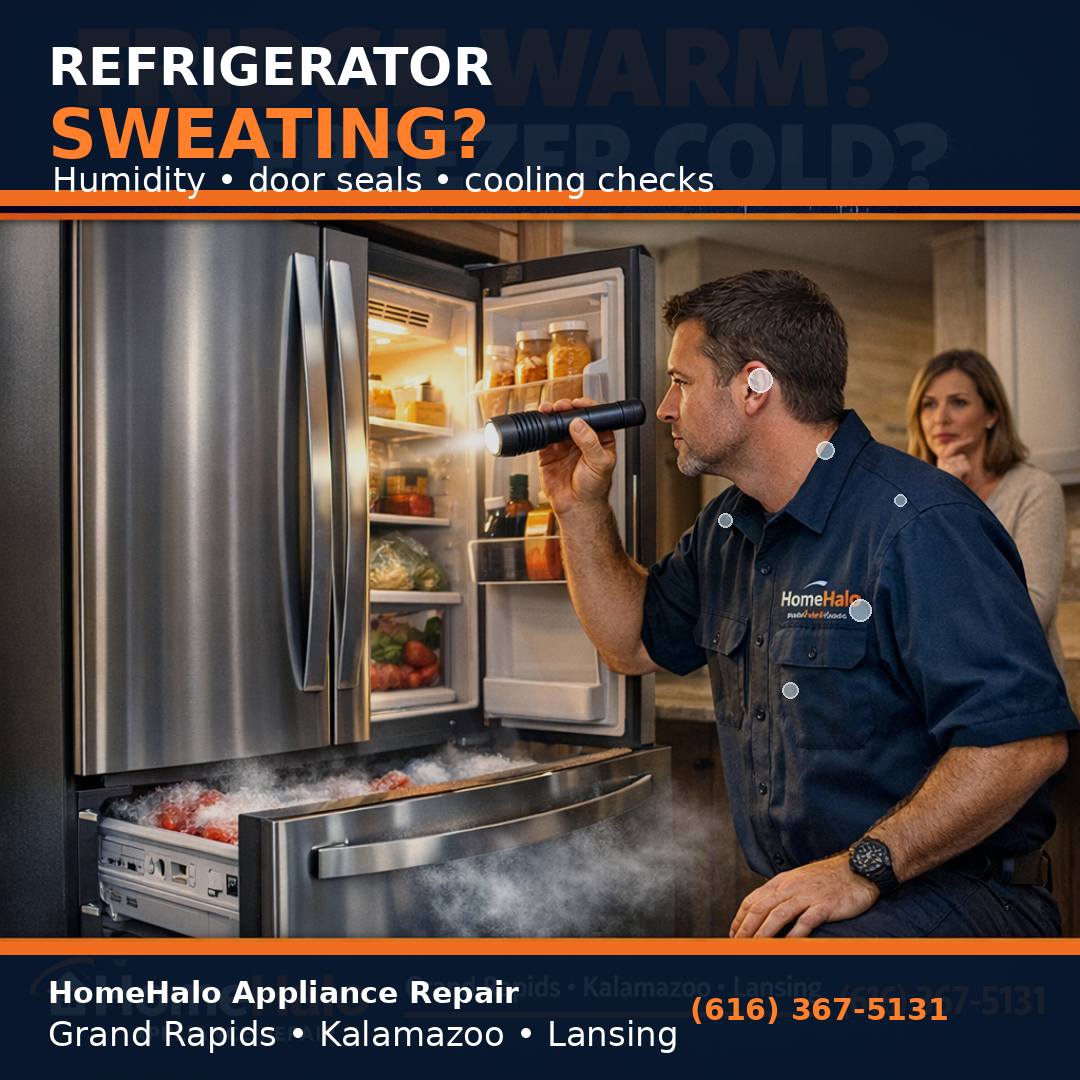
The key question is whether the sweating is brief and weather-related or whether it keeps coming back in the same spot. Here is how to sort out the likely cause before calling for refrigerator repair.
Why refrigerators sweat in humid weather
Condensation happens when moisture in the air touches a surface that is cooler than the dew point. The same thing happens when a cold glass sweats on a picnic table. Parts of the cabinet, door edge, gasket, dispenser area, or center mullion can become cool enough for humid kitchen air to condense.
West Michigan homes see this more often when the weather turns warm and muggy. Older homes, lake-area properties, basements, and kitchens without strong air conditioning can have higher indoor humidity. If the refrigerator is near a sunny window, dishwasher, oven, or poorly ventilated wall, the temperature swings can make sweating more noticeable.
First check the room humidity
Before assuming the refrigerator has failed, check the kitchen environment. If indoor humidity is above about 50 to 55 percent, exterior sweating becomes much more likely. A basic humidity gauge is inexpensive and can prevent unnecessary part replacement.
Try these simple checks:
- Run the air conditioner or a dehumidifier for a day and see whether the sweating improves
- Make sure the refrigerator has clearance around the sides and back
- Keep the refrigerator away from heat sources when possible
- Avoid leaving nearby windows open during humid weather
- Check whether condensation appears after the dishwasher, oven, or range has been running
If the sweating disappears when the room humidity drops, the refrigerator may be responding to the environment rather than a failed part. If one specific area keeps sweating even when the kitchen is comfortable, keep troubleshooting.
Door gaskets are a common cause
A door gasket is the flexible seal around the refrigerator or freezer door. When it is dirty, torn, warped, loose, or no longer sealing evenly, warm humid air leaks toward the cold cabinet. That moisture can condense around the gasket, door frame, center divider, or front edge of the refrigerator.
Look closely for food residue, cracks, gaps, magnets that do not pull firmly, or spots where the gasket folds instead of lying flat. Clean the gasket with warm soapy water, then dry it completely. Close the door on a dollar bill or sheet of paper in several places. If the paper slides out easily with almost no resistance, that part of the gasket may not be sealing well.
A weak gasket can also cause frost in the freezer, long run times, or fresh food temperatures that swing up and down. If you are seeing those symptoms too, compare this guide with our posts on why there is ice building up in your freezer and why your refrigerator is warm but the freezer is cold.
Check whether the door is closing completely
Sometimes the gasket is fine but the door is not closing all the way. Overloaded shelves, a drawer that is not pushed in, a food package hitting the door bin, or an uneven refrigerator can leave a tiny opening. That small gap is enough to pull humid air into the cabinet and create sweating around the door edge.
Open both doors and inspect the shelves, bins, and crisper drawers. Make sure nothing is touching the door before it seals. Then close the door slowly and watch whether it pulls itself shut or bounces back. If the refrigerator leans forward, the door may not close with enough help from gravity. Many models should be leveled so the front is slightly higher than the back.
Also check the center flap on French door refrigerators. If the mullion flap does not swing into place, the doors may look closed while still allowing air leakage between them.
The center mullion or door heater may not be working
Many refrigerators use a small heater around the door frame, center mullion, or dispenser area to reduce condensation. You may never notice it when it is working because it only warms the surface slightly. If that heater, wiring, control setting, or sensor fails, the same spot may sweat repeatedly even when the room does not feel especially humid.
This is one reason a refrigerator can sweat on the outside while still cooling normally. The food may be cold, the freezer may be fine, and the only obvious problem is moisture around the vertical divider or between the doors. A technician can check whether the anti-sweat heater circuit is receiving power.
Some models also have an energy-saver or humidity-control setting. If the setting is on energy saver, the refrigerator may reduce frame heat to save electricity. During humid Michigan weather, turning off energy saver or enabling humidity control can help. Check your owner’s manual because the wording varies by brand.
Condensation near the water dispenser or ice maker
If the sweating is concentrated around the dispenser, ice chute, or freezer door, the issue may be related to sealing rather than room humidity alone. A dispenser flap that does not close fully can let warm air enter the freezer door. That can create frost in the chute, dripping at the dispenser, or moisture on the exterior panel.
A clogged or slow water dispenser can also lead homeowners to confuse drips with condensation. If your dispenser flow is weak, our guide to why your refrigerator water dispenser is slow may help narrow that down.
For dispenser-area sweating, inspect the ice door flap, wipe the area dry, and watch whether moisture returns after ice is used. If frost appears inside the chute or the flap hangs open, it is time for a closer repair diagnosis.
When sweating means the refrigerator is working too hard
Exterior condensation by itself does not always mean the refrigerator is failing. But sweating combined with temperature trouble deserves faster attention. If food is getting warm, the compressor runs nearly nonstop, frost is building up, or the refrigerator cycles with clicking noises, the system may be struggling to hold temperature.
Dirty condenser coils, a weak condenser fan, airflow problems, defrost failures, low refrigerant, or control issues can all make the refrigerator run longer. Longer run times can cool certain exterior surfaces enough to collect moisture, especially in a humid kitchen.
If the fresh food section is not staying cold, start with our guide on why your refrigerator is not keeping food cold. If the freezer is cold but the refrigerator is warm, that points more toward airflow, damper, fan, or defrost problems than simple exterior condensation.
What you can safely do before calling
Start with low-risk checks that do not require disassembly:
- Wipe the sweating area dry and note where moisture returns first
- Measure indoor humidity with a small gauge
- Run air conditioning or a dehumidifier if humidity is high
- Clean the door gaskets and cabinet contact surfaces
- Check door alignment, leveling, and shelf obstructions
- Confirm French door mullion flaps are closing correctly
- Look for frost around the freezer, dispenser chute, or air vents
- Clean accessible condenser coils if your model allows safe access
- Verify refrigerator temperature is around 37 degrees and freezer temperature is around 0 degrees
Do not ignore water that reaches wood flooring, cabinets, or electrical outlets. Also avoid repeatedly lowering the temperature setting to fight sweating. Colder settings can make condensation worse and may freeze food without fixing the underlying cause.
When to call HomeHalo for refrigerator repair
Call for refrigerator repair if exterior sweating happens every day, moisture pools on the floor, one gasket area will not dry, the door does not seal firmly, the center mullion stays cold and wet, the dispenser area frosts over, or the refrigerator is also having temperature problems. These are signs that the issue may involve a seal, heater circuit, fan, control, defrost problem, or another part that needs proper testing.
HomeHalo Appliance Repair serves Grand Rapids, Kalamazoo, Lansing, and nearby West Michigan communities. Our technicians diagnose refrigerators from major brands in both residential and light commercial settings. The diagnostic visit is $179 and applies toward the repair when appropriate, so you get a clear answer before parts are replaced.
If your refrigerator is sweating on the outside and the simple humidity and gasket checks do not solve it, call HomeHalo Appliance Repair at (616) 367-5131 or use our verified contact page: https://homehalorepair.com/contact/.
Need appliance repair in West Michigan?
Same-day service available. Honest pricing. nearly 600 five-star reviews.
Find appliance repair near you
Need help with an appliance? Choose your nearest city to explore repair services and nearby coverage.
When to Call a Professional
- → The appliance makes burning, sparking, or unusual electrical smells
- → DIY troubleshooting hasn't resolved the issue after one attempt
- → The repair involves gas lines, electrical components, or sealed refrigerant systems
- → The appliance is still under warranty (DIY may void it)
HomeHalo serves Grand Rapids, Lansing, Kalamazoo & West Michigan. (616) 367-5131
💡 Key Takeaway
When in doubt, a professional diagnosis costs less than guessing wrong. HomeHalo provides free estimates and upfront quotes, you'll know the cost before any work begins. Call (616) 367-5131 for same-day service across West Michigan.